


Realistic Expectations - The Deeper Definition
- JotitOwl

- Dec 12, 2025
- 9 min read
Updated: Dec 28, 2025

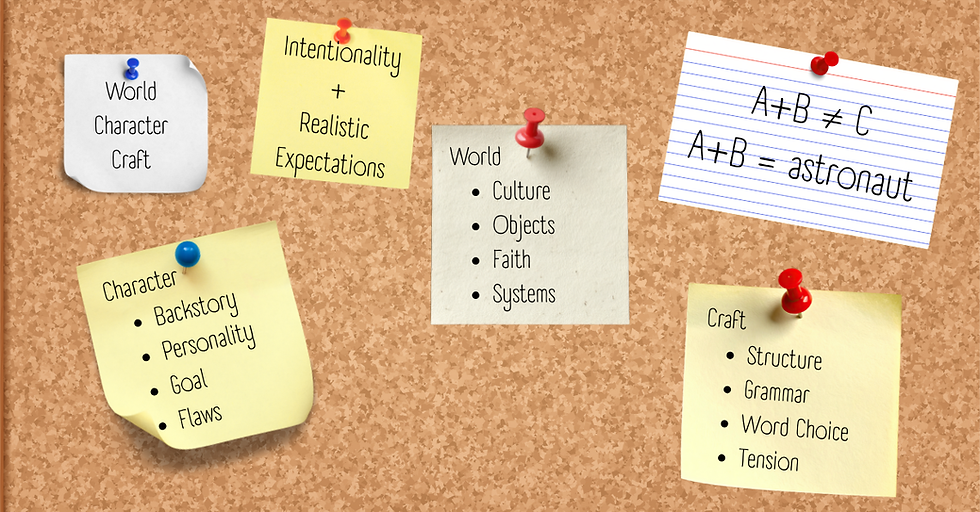
The last blog post I made mentioned my term "realistic expectations," but I really didn't get a chance to delve too deep into the idea. Realistic expectations is more than just an intentional balance between world, character, and craft. While I can say "balance it, balance it!" as many times as I want, the how is the problem. If that were all I said to you, I'd be no better than those who tell you "show, don't tell" and never explains themselves.
And I don't really like when that happens.
So! I'll do my best to explain what I mean. I hope it makes sense for you.
Why Love a Story?
Consider your favorite story. A novel, a movie, a podcast, a show, a short story, a poem, a game - anything will do as long as you love it. It should be the story you will always remember, the one you keep going back to time and again. The one you wish you could read again for the first time, but even though you know how it ends, you don't care.
Now, here are your big questions - Why do you love this story? Why does it keep drawing you in? What made it memorable for you? What stuck with you longer than any other story has?
There's a list of things that come to mind for me, things that I admire about those books. Vivid descriptions of towering castles, ancient cathedrals, war-torn battlefields, and idyllic countrysides live rent free in my head. Fantastic plots and moving action also spring to the forefront. Those detailed battle scenes and exciting, driven moments of sheer and utter terror and exhilaration described in the span of a few pages still make my heart race with excitement.
But each of these things has a common denominator, something that makes each of those places memorable.
Emotion.
Think about it. Was it really the way swords clashed and magic surged over a battlefield like a wave of light? Or was it the fear that came from someone we learned to love nearly losing their life to a person who wanted to take away everything they ever loved? Was it really the excitement of riding a dragon - wings beating with the wind as rider and beast rode air currents over vast cities and snow-capped mountains? Or was it the bond that grew between them as they learned that they were more than allies but family? Was it where they met - two characters in throes of a happy festival wreathed in light, laughter, and song? Or was it when they looked each other in the eyes and felt the walls they built start crumbling piece by tiny piece?
I know which one I remember more. I know which parts of the story made me laugh, fear, jump for joy, and sink into blankets trying not to sob.
Those who consume stories expect a certain level of believability. There's no denying the excitement of the scenes above, and I'm not going to stand here and say I don't like mindless shit from time to time. Sometimes, big emotions are too much. But we don't bond with things that fascinate us. We bond with things that make us feel something. Even the mindless shit makes me feel something - it makes me feel peaceful.
Fascination pulls us in, but emotion brings memory.
That is realistic expectations.
How People Respond to Realistic Expectations
Okay. Hear me out.
Bookstagram and BookTok.
If any platforms show the power of realistic expectations, it's those two. I'm just learning to navigate Instagram. I'm still nervous about getting onto TikTok (not great at videos; I'm not photogenic, lol). And don't forget YouTube. They get...passionate.
I love it.
Now real talk? You want the best example of how stories capture the heart and emotion? Go on there to see what's trending.
There's a reason the good stories make it to the top of the trending lists. It doesn't matter how vapid a story is to you personally, and you don't have to worry about everybody. What matters - what you need to worry about - is how your story can impact anybody. Popularity ≠ quality, but it can indicate what is currently being enjoyed.
Time will always tell in the end.
Modern technology and a value of self-sufficiency has drastically changed the book market. Self-publishing platforms like Kindle make it possible for authors to publish their books and completely bypass traditional publishing houses. Additionally, social media platforms have changed the way authors market their books, creating unprecedented reach. Like I said above, you want to know what's popular and trending, you should hop on BookTok, YouTube, and Instagram. These are now trusted sources of information. Word of mouth is a powerful tool, and people trust people far before they trust companies these days. A motivated and determined author (or obsessed and possessed author) can take advantage. Thanks to these new methods, books are flooding the market faster than ever.
Readers experience a rush of satisfaction that comes from reading and discovering stories that emotionally resonate, so much so that their very first instinct is to rush out and immediately promote their favorite stories. In the past, newspapers, magazines, bookshop windows, and word of mouth served as the tools for these promotions. Platforms like TikTok, Youtube, and Instagram are the modern parallel, and BookTok has been one of its loudest members. BookTok has promoted Stephenie Meyers’ Twilight Saga to no end. The same can be said for Sarah J. Maas’ series A Court of Thorns and Roses and Throne of Glass series. The hype surrounding these stories hasn’t quite died down either and their authors continue to receive consistent publicity.
Let's run a scenario.
Tell me about the dragon story. Which story? Just the dragon story. No, that's all. The dragon story. I want to know about the dragon story.
How many titles came to mind? Lots, I bet.
Okay, let's change the parameters a little. How about the dragon story with that one rider. Just that one rider. You know which one I'm talking about. That rider!
How many more titles came to mind?
What if I change the parameters more? The dragon story with the rider in school. The dragon story with that rider who talks to their bond. The dragon story with the rider who nearly falls off the back of their bond. The dragon story with the books full of notes on dragons. The dragon story with the war. The dragon story with the magic training. The dragon story with the magic slippers.
Maybe a few of these start to narrow it down. That last one? It can only be Dragon Slippers by Jessica Day George. Great story if you’ve never read it. I’m in love with the whole series.
But do you see how the term "dragon story" suddenly branches off into so many different stories? If you're not familiar, let me give you a list of stories that showed up when I typed in "the dragon story with the war" into google.
Game of Thrones by George R.R. Martin
Inheritance Cycle by Christopher Paolini
The Dragon Story: Secrets of War (Book 1) by Mycah Realms
The Dragon War Series by Denial Arenson
House of the Dragon meaning HBO's television series
Prince Lander and the Dragon War: Tales of Old Natalia Book III by S.D. Smith
Temeraire by Naomi Novik
And let's not forget Fourth Wing by Rebecca Yarros. Massively popular, surprisingly did not pop up the first google search, but hey, it was on my list!
And that's only the dragon stories with war. A Natural History of Dragons by Marie Brennan, The Hobbit by J.R.R. Tolkien, Dragon Riders of Pern by Anne McCaffrey, and The Hero and the Crown by Robin McKinley all include dragons of some kind and very famous or loved dragons. Then, there's the classics - Beowulf, Saint George and the Dragon, the Colchian Dragon from Greek Mythology, Tiamat from Mesopotamian mythology, Vritra from Indian mythology, Quetzalcoatl from Mesoamerican mythology.
So, so many.
Maybe at some point in history, "the dragon story" was enough to name the one story everyone thought of. Not anymore. There are too many. While dragons are still amazing and still gain attention quickly, it's no longer enough. You need so much more.
Most readers remember two things - the thing that drew them in (the dragon) and the thing that made them stay (what it made them feel).
That's what makes readers respond so powerfully to stories on trends and social media - what makes them stay to watch the life of a princess exiled because of her family's decisions rise to power through the strength of three dragons after the death of the man who bought her but whom she grew to love and become the Mother of Dragons; to read the life of a young man who found a dragon egg and became a rider bearing the mark of his bond and becoming the lynchpin in the war, who watched his uncle and cousin die because of that dragon egg; and to cheer on the adventures of one precocious hobbit and thirteen dwarves as they venture to take the dwarves' home back from the claws of a cruel dragon fighting for their future and against the same greed that damned their people from the start.
We stay for memory. We stay for emotion. We stay because the stories draw us in with more than just promises of action and adventure. Those are the stories that live in the minds and hearts of many around the world, the ones that make it through word of mouth. That is the inclusion of realistic expectations. Emotional resonance - emotion and feelings we can all understand.
Once you understand its impact, we can now talk about what it really is.
The Heart of It
To make something realistic, it must be believable. To make something expectant it must be something familiar. Realistic expectations are where believability and the familiar meet.
Now, don't come after me just yet. I'm not dogging on fantasy authors (hello! Fantasy author here!) Believability isn't needed in every aspect of storytelling. It's needed when writing two things - relationships and reactions. It’s not the dragon or even just the rider that makes the story memorable. It’s why they matter - to themselves or others - that makes the story memorable. Just because a story has been published doesn’t make it good writing.
But the opposite is also true. Just because a story hasn't been published yet doesn't make it bad writing. It all depends on how you approach your craft and how you structure, apply and maintain believable familiarity, or realistic expectations.
Author of The Science of Storytelling, Will Storr, proposes that "story emerges from human minds as naturally as breath emerges from between human lips" because of how deeply connected storytelling is to psychology. In fact, Storr himself turned to psychology and neuroscience because of the striking resemblance between the interviews he'd been conducting with experts in those fields and the how-to writing guides he'd pick up from the store. The result? A discovery of how the study of humanity led to deeper and better storytelling.
So, never say psychology doesn't have a purpose!
This is where realism begins to cross the line for me. Realism often implies physical realism - technology, motorized vehicles, ready information at our finger tips, comfortable clothing, and more. Real life equals believability
But that doesn't explain how stories like Brian Jacques Redwall series or C.S. Lewis' The Chronicles of Narnia series have withstood the test of time. If it were always about believability, fantasy would never have stood a chance.
Storr believes "compelling, profound, and original plots are more likely to emerge from character than from a bullet-pointed list. And the best way to create characters that are rich and true and full of narrative surprise is to find out how characters operate in real life." Notice how Storr’s focus is on psychological believability rather than the realism of setting, time, or place.
Believability doesn’t require the real world to be realistic, nor does it require a universal belief in what is relatable or believable.
Realism actually lives in consistency.
It’s an important distinction to have when it comes to fiction stories. Consistency comes with rules and laws, which build expectations. And expectations are built via a set of experiences that result in the same or similar outcomes. Realism only requires consistent results. That may be within the global market of a particular genre such as romance or fiction, or it may be within the limited view of the world a storyteller is creating.
Jonathan Gottschall, author of The Storytelling Animal, puts it like this: “The human mind is turned to detect patterns, and it is biased toward false positives rather than false negatives…[it has] mental software that makes us very alert to human faces and figures…this is part of a ‘mind design’ that helps us perceive meaningful patterns in our environments. Our hunger for meaningful patterns translates into a hunger for story.” These are the patterns that shape consistency in a reader and thus begin to build realism.
That is the truth of realistic expectations. They are unbelievably, inherently human. They are universal but also not. They are emotions and feelings, thoughts and understandings. They are shared experiences and empathetic responses.
They are humanity.
Give readers what they expect in terms of humanity, relatability, and believability and your story is one that will reach the right hearts and right minds. Rules don’t have to make sense to a modern world, but they do have to make sense in your world.
Consistency matters - even when islands float and whales swim through clouds instead of water. Moreover, characters can ride dragons, fight demons, and wield magic, but if they don’t feel sorrow when their best friend dies or feel joy accompanying a loved one to a local festival, then the writer may have a little more work to do in figuring out why.
Conclusion
Don't skimp on the fantasy if you don't want to. But don't skimp on the humanity. Even comedy builds humanity - it connects to the part of us that lives in happier emotions. Stories don't always have to be so dreary to be so powerful.
Whatever you choose to do, don't forget - you're writing to readers, to people. You have an audience of humans who operate within humanity. So write to it.

Comments