


The Intentionality of Writing and Realistic Expectations
- JotitOwl

- Dec 6, 2025
- 18 min read
Updated: Apr 17
Welcome!
Thank you for attending my TED talk.
Just kidding!
In all seriousness, I’m glad that you’re here. If you’re here, you’re probably curious like myself in what other authors have to say about the craft of writing.
I’ve been researching this stuff since I was nine years old. It became a sort of obsession over the years. The single most prevalent pattern I’ve noticed in every book I’ve read on the craft is that everyone and no one agrees all at once. Perhaps that’s because writing, like any art, depends on the person. It’s up to the artist. Take what works for you. Store the rest for later.
Some of this advice will sound like I’m pulling shit out of thin air. Other stuff might sound like I’m parroting experts. That’s okay. That’s where all of this comes from anyways - and I do mean both shit and experts. At the end of it all is just a philosophy on writing. It’s not a “live by the sword, die by the sword” mentality. Like any good philosophy, it has and will likely continue to evolve and grow, perhaps even changing fundamentally as I learn more and more.
With that being said…
I heard once that a philosophy is simply our belief in how life should be lived and why others should believe it, too. The Merriam-Webster Dictionary defines it as “a system of motivating beliefs, concepts, and principles.” My personal favorite is Cambridge Dictionary’s third definition: “the way that someone thinks about life and deals with it.” There are whole courses on the subject in college. We study differing philosophies at length. Those systems of belief were often ones that founded our own thanks to the cultures and social structures we’ve put in place long ago.
In practice, then, a philosophy is an evolving definition measured by the sum of personal understanding and learned experience that is then applied to our lives, which are ultimately shaped by how we apply it.
In other words, they’re designed to help us self-reflect, and then to get better.
Philosophies can be applied to anything we practice. It can change. It can grow. The best ones always do. As life shows us new things, so too does it deepen our understanding. But it’s of no use to anyone unless we actively seek it out.
I suppose that’s why I decided to start looking at my personal writing philosophy - I wanted to understand the craft that I love with something bordering on obsession. Which, according to Jeff Vandermeer, is not a bad thing: “What is obsession but curiosity and passion taken to an extreme?…obsession is an essential part of creating an enduring work of art.”
Understanding what I know - and vice versa, understanding what I lack - is, I believe, a vital piece to how the writing process plays out in my head. And exploring what I don’t know is always interesting, because I learn more from admitting my faults than ignoring them.
So, if you’re interested in what I’ve learned, feel free to keep reading.
Writing must be intentional and deliberate
Any storyteller knows this, tucked perhaps in the deep annals of some dusty little notebook they used to scrawl in during classes and lectures. It’s been repeated by many before me, and will be repeated by many after me. It’s also one piece of advice I bucked at.
Why does writing have to have a motive? Why can’t it just be fun?
It can be. But even then, that is the motive - fun.
If you’ve never attempted to write a book before, you may not realize how utterly consuming that art is. The desire to build a world that was other - other than ourselves, other than our world, other even than reality - was to us a siren’s call from the depths of a massive ocean. We did not go into this lightly. We at least perused the shelves of some dive shop, searching for the bare minimum of what we needed before jumping straight into that ocean. Knowing about something and doing it well are two vastly different things. You can’t just know writing. You also have to be prepared to do it. So, to go into it without a plan or care in the world sounds, frankly, insane.
Without intentionality, we are listless. That’s not to say we always have to know where we’re going - hello, pantsers! It’s good to see you here - but even those who don’t have a road map at least know what they’ve chosen to do and are well-prepared.
Those who have interacted with children at length have probably endured through the stage of childhood where impulses and intentions don’t always equal positive experiences. Remember that time in your life where you learned not to touch the stove? I bet your parents told you before you did it. I always hated it when they would remind me over and over again:
“Don’t touch the stove. It’s hot.”
“I know!” said confident little me while still reaching.
Let’s just say my little know-it-all-ass quickly learned to listen about hot burners.
My parents had a phrase that as an adult, I love. As an adult. As a child, it irritated me.
“If you know it, do it.”
“If you know that you’re supposed to brush your teeth, do it.”
“If you know you’re supposed to wash the dishes, do it.”
“If you know you’re not supposed to touch the stove, don’t!”
Ugh.
But…I mean, they were right.
It’s worse in pre-pre-teens. Erik H. Erikson, one who studied developmental psychology, believes it comes between the ages of 6 and 11, but in my personal experience, I have found awareness hits the hardest around ages 9 to 11 instead. His theory about this stage of life is called industry versus inferiority. A child develops industry, or the desire to work and apply skill to situation. Productivity is high and the desire to be productive follows. But at the same time, inferiority develops - the sense of inadequacy that comes from understanding that their skills and abilities are not enough to succeed easily anymore.
It’s here the “I knows” begin, that era where they want to be good kids, want to be themselves, and don’t know how to be both without someone getting hurt in the meantime. And they find out quickly that there is more in this world than just themselves and their own feelings - there are others in this world with the same or different feelings and experiences. They don’t know how to reconcile that when they’ve been the center of their world for so long. Because of this, “I know” begins to form a shield. “I know” translates into “I know it, but I don’t want you to know that I really don’t know it.” And like my parents before me, I remind them of the simple rule: “If you know it, do it.”
I miss how simple things were at that age. Following rules was simple. Be kind. Be respectful. Don’t call names. Put your things away. So were the instructions. This is how you subtract across zeroes. Use this formula to figure out area. A verb is an action word. All tried and true steps, procedures, and terms that become certainty after practice.
But we forget that in the moment when we were living that, it wasn’t that simple. It was a time of uncertainty, of big emotions and the struggle to understand the “why”s of the world. Every step forward becomes an intentional and deliberate act of trying - sometimes failing - to find the next stable step and wobbling on one leg. And in the end, most of us just become “good enough to pass” without striving for more because “good enough” is safe.
We never really leave that as adults. It just becomes…subtler. We carry it closer, playing it close to the chest because we don’t want to admit there’s a chance we might just be mediocre. But we need to give ourselves the chance to prove it’s not the truth of us.
Storytelling is like that experience. It’s like being 10 again and trying to figure out where the next step is while blindfolded. It’s rarely as simple as it sounds after the fact. Everyone “knows” how to do it. Not everyone can do it well, and only those who admit that it takes work will ever step past their own inferiority. Storytelling has both straight lines and curved lines, bends and angles. Just think geometry for words, and you’ll get a close proximity.
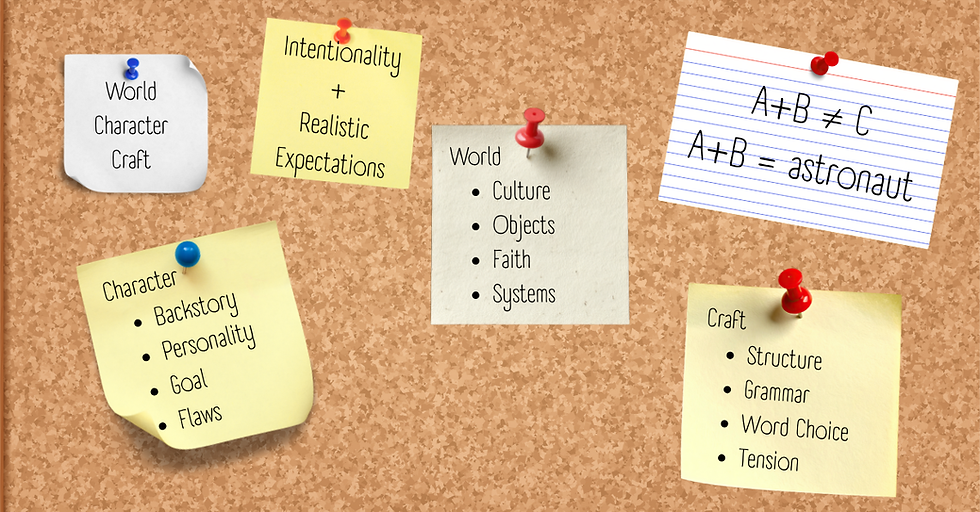
I’ve personally found that the best writing advice comes from people who admit fully that this art isn’t as straightforward as formulas. A+B≠C. Sometimes, A+B = astronaut. This is the advice you get from the people who wobbled and still pushed forward. The obsessed. Like I said before. Take what you will to make it yours, but I won’t ever claim this is solid “do it my way and you’ll be the perfect storyteller.”
Ha!
No.
This is more like “this worked for me and maybe it will work for you, too.” I don’t recommend it. I’m fairly certain my brain has its own reality setting. But you really never know until you take that first step forward and give it a chance.
If you’re still here, well…I warned you.
World, Characters, Craft
The three Bigs!
These are the cornerstones of good writing. Storytellers often find themselves caught up in the tenuous balance between all three of these, especially the first two. It’s almost like they repel each other. Leaning too far into world building results in flat characters and poorly executed growth arcs. Likewise, too much character work results in a lifeless, unanchored ghost world.
Let’s put it this way.
Characters should be fully realized. They should have everything real people have: thoughts, feelings, emotions, strengths, and flaws. They are the ones who breathe life into the world. Their experiences are unique. No two characters will perceive the same situation in the same way.
But the story is more than just the characters. It’s land and culture, other people and creatures, items and systems. These things inform the world in which the characters grow, learn, change, and go on their adventures. Their very existence can develop the conflict that drives a story forward. Without a world for characters to live in, what’s the point of it all?
I was recently challenged by a writing partner to answer this question: Explain the difference between "plot-driven" and "character-driven" narrative. Which do you think is more effective, and why? To me, this question laid the foundation of this argument because it highlights the best of both - world and character.
Plot-driven narrative relies heavily on story - that is, the focus is world, setting, and events. You have characters, yes. But plot-driven narratives do not require the characters’ actions to push the gear into full drive. Plot is an inevitable fate and the world its tool. Things happen to the characters, and we get wrapped up in the events rather than the characters themselves. We still get internal thoughts, personal ideologies, motivations, and goals, but they are shaped by the world.
On the other hand, character-driven narratives rely on personal motivations and goals. Characters drive the events of the plot forward. The story focuses more on character choice and action/reaction to external events. The world is shaped by the characters, and internal conflict weighs more heavily.
Most would think that the character-driven plots would be the obvious choice to this challenge question. At least, that would have been my instinct several years ago when I first started this journey. You’ll also find a lot of the arguments in this book to center around human psychology and the way writers use them to manipulate the emotions of our readers. I regret nothing! Readers beware! And if you’ve read any of my work, you know that I myself like to focus on the internal conflict of characters and allow their actions to drive plot forward. Seeing the character up close builds empathy, empathy builds investment, and investment is where you want a reader to eventually end up because that will determine your future as a writer. A reader will not buy a story they are not invested in, nor one that has no potential to develop investment for them.
However, I personally disagree with the notion that one - plot or character - is superior to the other.
Lord of the Rings, for example, is plot-driven with a primary focus on world events and character reactions to those events. Frodo is given the ring. He reacts by bearing it to Elrond’s home. There, the council argue over who is best suited to carry it to Mordor only to have our hobbit protagonist be compelled by some power to offer himself up: “As last with an effort he spoke, and wondered to hear his own words, as if some other will was using his small voice. ‘I will take the Ring,’ he said, ‘though I do not know the way.’” It’s not clear if this is an act of the ring or an act of Frodo’s own moral compass. Regardless, he takes the ring. From there, his role is relegated to resisting both the external forces sent against him and Samwise and the internal whispers of the ring. Most things happen to Frodo instead of him creating conflict through personal choices.
Just as well, Pride and Prejudice is one of my favorite examples of a character-driven narrative. The focus on the internal conflict and the characters’ personal motivations and goals drives the plot forward. Elizabeth resists the idea of marriage, likening it to a loss of control, and Darcy resists falling in love for much the same reason. Each make decisions that inevitably lead them into more misunderstandings created by character choice. For example, Darcy’s thoughtless words at the beginning prime the path into hatred for Elizabeth, yet her stalwart objections and personal feelings lead her to judge him too harshly on many accounts. Each decision, each admission of mutual dislike and confessions of feelings towards the other brings them closer to each other until finally Elizabeth accepts that he has only ever been kind to her and her family and they are pushed into each other’s arms in the end because of what Darcy did to protect her sister’s - and adjacently her family’s - reputation in high society.
J. R. R. Tolkien and Jane Austen are both highly celebrated authors writing with vastly different narrative tools. Saying that one is superior to the other is, frankly, sacrilegious.
I find a blended approach can often enhance a story. This is where both worldbuilding and character development are equally required. I don’t want to imply that there is always going to be a perfect 50/50 balance. One can ultimately take priority over the other depending on what the writer wants the driving forces to be, so it can also be 60/40 or 70/30 or all three depending on what part of the narrative the writer finds themselves.
A perfect example of the blended approach would be Avatar: The Last Airbender. Aang’s story, not Korra’s. This is a series that used both plot and character driven elements depending on what the narrative needed in the moment. You have plot driven events in the very beginning of the story, in fact. Katara and Sokka just happen to stumble across the iceburg with Aang and Appa? And Zuko’s proximity to the area was in hindsight suspiciously fortunate for him. The fire nation’s actions before the story even began also shaped the narrative before the characters even had a chance to react, and the moments of Appa’s kidnapping driving the characters to find the depth of the corruption of the earth kingdom and Jet’s eventual death were also thrust upon them.
But there were also characters’ internal motivations that served to drive the story forward. No one better personifies this than Zuko.
Zuko had come close several times to catching Aang, but each choice and failure drove him further and further from his biological family and closer and closer to the realization of his family’s flaws. He could have simply accepted them, and nearly did for a time, but his self-reflection and honest conversations with the one person who truly loved him for him from the beginning - the best uncle in the world, Iroh - eventually brought him to the choice that would change the trajectory of the story forever. That one decision saved the rebellion as a whole and laid the foundation for Ozai’s eventual defeat.
Think of it like the world of a video game. Players rave about more than just the plot and character backstory.
"Check out the scenery! The graphics are crazy!" they might say standing on a cliff and overlooking an in-game sunset.
"This NPC's backstory is deeply suspicious..." they might say about the average milk seller on the corner.
"I've spent hours hunting down this weapon. It's supposed to boost all your stats by five!" others say after an adventure.
You get a balance of both. Without plot and character, you have a world with nothing to do. But without NPCs, objects, items, systems, cultures, and rules, the player - or in the case of a novel, the character - may lack motivation or the means by which they are able to achieve their goals. Then there's no story.
Craft is the bridge between the two entities. It’s the one thing that makes it possible for readers to learn about both character and world. As storytellers, we hone our craft as much as possible to make our worlds interesting and important. We cannot ignore the power of a well-crafted sentence. Also consider structure, tension, conflict, phrasing, and word choice - these are the missing links that build the balance between the characters and the world.
There is a reason storytellers study grammar at length. It isn’t just to make the perfect sentence. It’s to know the rules…and eventually learn how to break them. A word at the right moment can change a reader’s perspective about a character or setting. Likewise, a well-placed descriptor creates the difference between “this conversation is innocent” and “this conversation has teeth.”
Tell me the difference between these two sections:
He eagerly shook the dean’s hand. Tears sprang to his eyes.
“Thank you so much for this opportunity, sir,” he said.
His smile stretched from ear to ear.
The dean nodded, smiling back. “Of course. It was all your hard work that paid off in the end.”
He eagerly shook the dean’s hand. The grip was firm. Too firm. Tears sprang to his eyes.
“Thank you so much for this opportunity, sir,” he said.
His smile stretched from ear to ear.
The dean swallowed and nodded, forcing himself to smile back.
“Of course. It was all your hard work that paid off in the end.”
These two sections have roughly 80% similarity to each other, yet the subtle differences of word choice create two completely different situations. The first is eager, excited, and has a positive vibe. Words like “eagerly” and the visual of the tears in his eyes create that sense of accomplishment and wonder for the young man, and the smile is the moment we know how elated he is. The second, on the other hand, has “wrong” written all over it. The firmness in the grip and the nervous swallow of the professor suddenly create different context for that smile, and we suddenly realize that smile is probably hiding something far more sinister.
Craft is how a storyteller builds their worlds and characters and allows them to show their creations off. If those two are the finished house and its pretty decorations, craft is the nails and framework, the soldering and the concrete that establish that firm foundation.
There is one thing that really shows off what all three can do when balanced well.
Delving into Dungeons and Dragons
No, I’m serious. You want one of the best examples of how world, character, and craft can be expertly balanced, check out Dungeons and Dragons.
D&D, if you haven’t heard of it, is a table top role playing game. The quick of it - adventure-packed hours of campaign nonsense, insanity, and bad decisions. The long of it - it’s absolutely gorgeous. The immersivity of the game is its true strength, but its secondary is the flexibility it presents to both the host and the players. The one who runs such games - Dungeon Masters, also known as Game Masters - is much like the writer of the story, and the players are a lot like the characters. And much like writing a story or novel, DMs will often go where the characters lead them. Thanks to the dynamic between all these elements, the balance between world, character, and craft is achieved.
The Dungeon/Game Master, or DM/GM, runs the world. Literally. They are the ones who create immersive adventures, keeping worlds consistent while building structures, systems, and circumstances with specific roles and problems tailored to the character motivations. DMs devise encounters with both monsters and the BBEG, or Big Bad Evil Guy. These can be simple travel encounters, or perhaps they are in response to the cultures and civilizations they have established in this world. DMs are also responsible for the conception of Non-Player Characters, or NPCs. These characters are non-players, and yet their very presence often indicates a specific role and purpose that can directly influence the players’ perceptions, providing items or perhaps paths to items that players can acquire. These items can help players immensely. They can hinder players immensely. And no one knows which it is except the Master themselves. Each factor, carefully chosen, develops the setting, and with it the world itself.
The players, on the other hand, are the world’s inhabitants. They create the main protagonists - sometimes even antagonists - of the adventure. But these aren’t simple characters on a page. To them, these characters are ones who live, breathe, and hurt like real people. Their choices lend to their overall experiences of success, failure, heartbreak and even death. They are the ones who make the world a living thing as they interact with and manipulate the things inside this world. They eventually shape the world they’ve chosen to submerge themselves in and give weight to repercussions that ripple outwards.
It’s here where the two begin to interact in interesting ways. See, if it’s done correctly, a unique push-pull system will begin to emerge. That’s where the flexibility of D&D begins to support and cultivate the immersivity. We know ourselves that the world isn’t one to simply sit there and let things happen. Plot-driven narratives are what they are because of this truth, after all. But the strongest of us, those who have survived what the world burdens us with and come out the other side, know that the only way to survive the plot isn’t to simply lie down and let it happen. We push back. That’s what the players will do.
The world acts. The players probe. They wake a nest of trouble. The players react. The world resists. So do the players. And as the story progresses, the cause and effect, or action → reaction → reaction structure evolves from the ashes.
It’s a system of consequences. Natural, choice-born consequences. And the individuals will attest themselves it’s a rather addictive system, too.
Craft is the responsibility of both the player and the DM, but I would argue from my research and observations that the DM holds the highest responsibility for this. Remember, craft is the bridge between world and characters, the bones and framework that hold everything else up. It is also responsible for the immersion needed for a game like D&D.
DMs need strong control of game mechanics - that’s tone, pacing, and plot devices. They also need to know craft mechanics like word choice and phrasing to make things as engaging with the players as possible. An engaged player is an eager player, and an eager player is always the best kind of character. Have you ever seen how quickly DMs can turn a phrase or whip out a monologue? Don’t get me wrong - a lot of it can be preplanned. DMs spend a lot of time preparing sessions for their players. But there’s this stereotype - which, by the way, would never have become a stereotype if it weren’t happening so many times - of players making diabolically stupid decisions and ruining a DM’s previously planned campaign. Either they die, or they become chaos incarnate. I sometimes wonder which one the DM would prefer. Those are the moments that require split second decisions on where to take the story next because all of your prepared content is suddenly not enough or now irrelevant. That is pure storytelling art, and immense skill.
The careful balance of the three Bigs - world, character, and craft - is what gives this game the popularity it holds today. Where once it was the territory of, dare I say, the “nerds,” it has now reached world-wide popularity in no small amount of thanks to groups like Dimension 20 and Critical Role as well as popular Dungeon Masters such as Brennan Lee Mulligan, Aabria Iyengar, and Matthew Mercer. My own experiences with D&D are somewhat limited - I do not have a group of friends I could hold captive for hours on end in a story world - but if you’ve never watched a session or experienced any of these DMs in action, I pity you - you have missed out on masters of craft.
I challenge you now to stop reading here and go find a game to watch. I personally recommend Dimension 20’s Misfits and Magic campaign, or Critical Role’s campaigns that eventually led to the newly animated series Vox Machina.
If you are already experienced, feel free to read on.
Vocabulary word for you: phenomenon. Fun word, and one of my favorites. The definition of a phenomenon is an event or situation that is observable and can be measured. The phenomenon that I have chosen to study obsessively is this immersivity of one who experiences a story. My observations have led me to understand that it is achieved through the careful balance of world, character, and craft, along with a hefty dose of intentionality.
And just so we’re clear, you need all of it.
This process is what I have begun to call the inclusion of realistic expectations.
My Writing Philosophy
The elements above shape the way storytellers approach story. While worldbuilding, character building, and craft work are essential to the creation of a good story, intentionality is essential to its success. Intentionality is the series of deliberate decisions created around a chosen design. Like an architect, a storyteller must look at all the angles. Height, foundation, and weather can affect the construction, so they choose the materials best designed to help withstand and even bear the brunt of what is to come. Storytellers should approach a story with the same care.
There are many stories that have withstood the test of time because of this balance. We’ve already seen several examples of these above. A few more honorable mentions might be classics such as The Chronicles of Narnia by C.S. Lewis; more popular modern day series like The Witcher, including both the books and the game series; and the Marvel Cinematic Universe - arguably only the beginning phases, though; I, too, am not a fan of the way Disney has chosen to take this series. This is because stories such as these have chosen good storytelling techniques that allowed both their worlds and their characters to not just shine but also build legacies.
Authors, screenwriters, film directors, playwrights, comic artists, writing coaches, decent editors, game developers, and the average consumer of stories are all familiar with the power of a story and the effort it takes to craft and consume them. And many of us just want to know more.
I have researched and synthesized many experts before me. What notes I've taken and what things I've read have formed the central ideas of this book. You’ll see authors like Sandra Gerth, Joseph Campbell, Jeff Vandermeer, Jonathan Gottschall, Will Storr, and Shawn Coyne mentioned within these pages. Perhaps others, too. See, these aren’t new beliefs. I’m definitely not the first. Terminology varies, but everyone would agree that there is an underlying belief that leads all of us to eventually search for an understanding and a way to deepen our craft.
We believe stories are worth it. We believe the telling of them is sacred. And we want others to love them just as much as we do ourselves.
There is, therefore, only one conclusion that I’ve come to about stories, and it’s this conclusion that guides the path, every path, forward:
The world does not revolve around the characters. Rather the characters interact with and influence the world - and the world is allowed to push back.
That's what drives every story I plan, every world I create, every character I discover, every plot I invent. It works. Most of the time. And for the times that it doesn’t work, that’s when a writer must trust their instincts.
So, here’s your goal: Learn something new. Or maybe learn something useful. And if none of that is possible, learn what you want to remember.
Just so long as you’re here to learn.


Comments